Illustration of a container ship at sea
ECO EFX Solutions · Industry overview

Shipping & marine

Who pays for bunkers, and who carries the carbon cost: the shipowner or the charterer? Start the voyage budget with the charterparty and the bunker account.

Preparing an application review on board

When a review is useful

Identify the specific main or auxiliary engine and its duty profile. Fuel use can only be meaningfully compared with the work delivered and the operating conditions; engine suitability is not assumed.

What data to prepare

Engine and air-filter configuration; fuel type and quantity, load or delivered output, operating hours, routes and maintenance for comparable periods. Identify who buys the fuel and bears the relevant costs.

What to discuss with ECO EFX

Discuss the intended engine application and available records with our team. Clarify the technical requirements and comparison conditions before considering an operational trial. Suitability and any effect remain application-specific.

Discuss your application
Why it matters

Whose budget benefits from one less tonne of bunker fuel?

Three questions determine the voyage account: who buys the fuel, who bears the allowance cost after settlement, and who funds the measure? They need not be the same party.

Use annual tonnes by fuel grade for the fleet budget and the invoiced currency per tonne for each grade. Reconcile deliveries with opening and closing stocks and any transfers. A bunker delivery note records fuel received; by itself it does not show what the ship consumed on a particular voyage.

Operating arrangementWho pays for bunkers?Where does lower consumption affect the accounts?
Owner-operated, no charterThe owner buys fuel for its own account.At the same transport output, the owner first sees a lower bunker expense. The business case also depends on implementation costs and any amount passed on to customers.
Time charterThe charterer normally provides and pays for bunkers. Account for off-hire periods under the charterparty.If the owner funds a measure and the charterer buys less fuel, that reduction alone generates no cash for the owner. Look for an agreed reimbursement or a share of the benefit.
Voyage charterThe owner normally budgets for bunkers as a voyage expense. A bunker price clause may pass on price movements.At fixed freight with no subsequent adjustment, lower fuel use first improves the owner’s voyage result. Check whether ETS costs are included in freight, charged separately or settled by a transfer of allowances.

EU ETS: surrender obligations and cost allocation

The responsible shipping company remains liable for surrender. Reimbursement shifts cost between parties; it is not a second vessel expense. For the 2026 emissions year the full surrender obligation applies to emissions within EU ETS scope, including CO₂, methane and nitrous oxide. Allowances are due by 30 September 2027. The route and any applicable exemptions still determine which emissions are covered.

European Commission: maritime EU ETS ↗
Vessel budget case · Baltic ferry · 2025

What does a tonne of fuel mean for the owner’s budget?

In 2025, Stena Germanica reported 13,682.11 tonnes of fuel consumed. At that volume, a change of USD 10 per tonne in the weighted average price moves annual bunker expenditure by USD 136,821.10, with service and consumption held constant. Who bears that movement depends on who pays for the bunkers.

01 / Reported operations

A ferry, two reporting years

Stena Germanica (IMO 9145176) is a passenger and freight ferry. The figures cover its annual EU MRV reporting scope. Fuel is the total across grades; CO₂ is reported carbon dioxide, not all greenhouse gases in CO₂-equivalent and not the number of allowances due.

Source: EMSA · THETIS-MRV public reports. Select 2024 or 2025 and search IMO 9145176. Read the vessel’s annual rows · cross-check the figures. Open the full reporting period, then Annual monitoring results → Fuel consumption / Emissions. Table values are shown to two decimal places; the cross-checks round to whole tonnes.

Annual activity within MRV scope · metric tonnes
Reporting yearFuel consumedCO₂ emitted
202413,399.3142,958.19
202513,682.1143,756.45
Change+282.80+798.26

A larger annual total does not establish poorer efficiency. Compare sailings, passenger and freight output, weather and time at berth before attributing the difference.

02 / Decision threshold

How many tonnes would pay for a measure?

As a separate price reference, Hapag-Lloyd reported an average bunker consumption price of USD 528/t across its fleet in 2025. For every illustrative USD 10,000 of annual measure cost, the fuel payer would need to avoid 18.94 t/year at that price (10,000 ÷ 528), if it also funds the measure. No separate carbon benefit is counted.

Hapag-Lloyd · FY 2025 Investor Report, Group earnings position. This container-fleet average is not the ferry’s price or a current quote. The threshold is arithmetic, not an expected reduction.

03 / Contract and carbon

Follow the invoice and the settlement

Start with the party buying the fuel. Then trace the allowance cost and any reimbursement under the charterparty. A reimbursement shifts expense between budgets; it does not create a second cost for the vessel. The public ship record does not identify either party’s settlement.

For 2025, the EU ETS phase-in was 70% of emissions subject to surrender. Voyage scope and applicable derogations matter. Use the reconciled allowance quantity allocated to the vessel. Do not multiply its total MRV CO₂ by 70% and treat the result as a bill.

EU ETS Directive · Articles 3gb, 3gc and 12 · European Commission · shipping ETS guidance.

How a reimbursement divides USD 100 of ETS cost
Owner side · USD 25Charterer · USD 75

Illustration: if the charterer reimburses 75%, the owner pays USD 100 and receives USD 75 back. The combined cost stays USD 100. These are assumed terms, not this ferry’s contract.

Ways to reduce costs

Operating decisions

If berth, fairway and pilot availability are confirmed, compare a revised passage speed with steaming faster and then waiting. Separate propulsion from auxiliaries and boilers. If sludge is the expense, examine bunker compatibility and separator records first.

What to measure

Compare tonnes per equivalent voyage and auxiliary tonnes per port stay at the agreed service level. Include charter terms and identify who pays for bunkers, delays and treatment.

Technical references: IMO · GreenVoyage2050 ↗

For suitable combustion engines, nanoEFX is costed per filter application; fuel additives are costed on the quantity of fuel actually treated. Compare with unchanged maintenance and the same useful output.

Interpreting the operating figures

Begin with the annual fuel quantity for the assets being assessed, expressed in metric tonnes if that is how the fuel is purchased. Match the price to the same fuel grade and tonne unit; a litre price cannot be used without an appropriate conversion. Keep propulsion, auxiliary generation and other consumers separate wherever metering allows. Voyage speed, weather, cargo and time at berth can change the comparison. A valid business case should also identify whether the owner, charterer or another party purchases the fuel and bears implementation costs.

IEA: International shipping consumed 4.2 million barrels of oil per day in 2023; the sector accounts for about 5% of global annual oil use. Source: IEA · How the shipping sector could save on energy costs (2025) ↗

Visual industry analyses

Which voyages account for reported maritime CO₂?

EU MRV · 2023–2024

Share of all CO₂ reported by the EU MRV fleet attributable to voyages between an EEA port and a port outside the EEA. This percentage is not the share of emissions payable under the ETS.

% CO₂
  • 202365.7 %
  • 202470.6 %
Source: European Commission · COM(2026) 173 final ↗
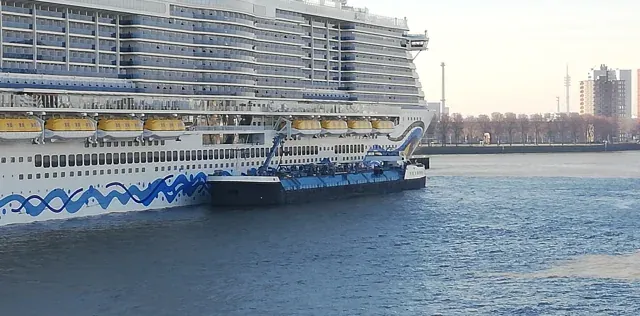
LNG bunkering alongside a ship in Rotterdam.
Operating context

LNG bunkering alongside a ship in Rotterdam.

Raffnix2000 · CC BY-SA 4.0 · WebP
Data for your assessment
Operating recordWhat to collect
Voyage profileSeparate time at sea from time in port and record the cargo carried.
Fuel quantityRecord annual tonnes by fuel grade and by engine where metering permits.
BudgetIdentify the bunker purchaser and invoice currency. Keep separately payable carbon costs distinct.
Regional energy use

EU maritime action

International shipping: about 700 million tonnes CO₂ per year (IEA, 2025 estimate). This is a global sector estimate, not a result for any product.

For ships in scope, the general rule covers all emissions on voyages between two EEA ports of call and all emissions within an EEA port. On a direct voyage between an EEA port and a port outside the EEA, it covers 50% of voyage emissions. This is a share of emissions, not a share of voyages; applicable exemptions still matter.

EU ETS ↗Source · IEA ↗

Regional questions for your operation

The same comparison needs may be expressed with different fuel, vehicle and unit labels. Use these questions to prepare your operating records and discuss the intended application with ECO EFX.

Europe: DACH, UK, Scandinavia and SpainWho benefits from a lower bunker-fuel bill under the charter?

Identify the fuel buyer, contractual cost bearer and specific engine. Keep operating fuel use separate from contractual reimbursement.

USA and CanadaDoes the bunker record state mass or volume?

Record the fuel type and exact quantity unit. Any volume-to-mass conversion needs the documented basis; do not assume a universal density.

Spanish-speaking Latin AmericaWhich costs belong to the vessel’s combustible or bunker budget?

Separate fuel quantities, purchase price, voyage period and contractual payer. A lower invoice alone does not demonstrate lower consumption.

South Africa and West AfricaIs the enquiry about coastal, inland or auxiliary-engine operation?

Identify the vessel and specific main or auxiliary engine. Record load, operating hours and fuel use rather than assuming a common vessel profile.

Saudi Arabia, UAE, Oman and QatarHow should propulsion and auxiliary-engine loads be distinguished?

Keep main and auxiliary engine records separate. Document fuel type, delivered work, operating hours and the party bearing each cost.

IsraelWhat should Hebrew or English vessel records identify?

Use consistent fuel and output units and name the engine, operating period and fuel buyer. Technical suitability requires application-specific assessment.

RussiaHow can marine fuel use be compared across operating periods?

Match the specific engine, fuel type, load, operating hours and voyage conditions. Keep consumption quantities separate from purchase prices.

IndiaWhich records are needed for an Indian vessel application?

Identify the main or auxiliary engine and its filter configuration. Prepare fuel, load and operating-hour records for comparable periods.

ChinaHow should vessel fuel consumption and delivered work be linked?

Describe the vessel’s service and the specific engine. Keep route, load, fuel type and operating period visible in the comparison.

Questions for finance teams

Who surrenders EU ETS allowances if a charterer pays for fuel?

The shipping company responsible under the EU ETS remains responsible for surrendering allowances. Where another entity assumes contractual responsibility for purchasing fuel or operating the ship, the company is entitled to reimbursement for surrender costs. Check the charterparty and settlement records before allocating a cost to either party. EUR-Lex · 3gc ↗

How do I keep a carbon surcharge out of the budget twice?

Separate the bunker invoice, the ETS settlement and any recharge to the other party. If the price entered in the calculator already includes the same carbon cost, select the included-cost option. Model a separate charge only for the share actually borne by the budget you are examining.

Can the fleet calculator stand in for a verified emissions report?

No. It illustrates combustion CO₂ using fuel quantity and a fuel-specific factor. For an ETS budget, check vessel and voyage coverage, the emissions year and the applicable gases. The calculator’s CO₂ component is not a full CO₂-equivalent inventory or an allowance settlement. EU ETS ↗

Discuss technology use for your vessels

Describe your vessels and marine engines, their engines and typical operating conditions. Discuss with our team what information is needed to assess a potential application.

Discuss potential applications