Illustration of an excavator working on rocky ground
ECO EFX Solutions · Industry overview

Construction & heavy equipment

An excavator can burn less diesel per hour and still make the job more expensive. For a bid or a budget review, start with the cost of the excavation the client accepts.

When does lower hourly fuel use reduce the cost per cubic metre?

Match the shift’s fuel, labour and equipment costs to the accepted quantity from the same work package. If fewer cubic metres are delivered each hour, the crew, the excavator and the waiting trucks may be needed for longer.

Agree what counts as a cubic metre

Use the measurement basis in the contract. A survey of material in place, loose volume in a truck and compacted fill describe different quantities. Compare like with like. If weighbridge tickets give tonnes, use the documented density for the same material and condition, or keep the comparison in tonnes.

FHWA · Earthwork Representation · Table 4

Build the cost from the shift record

Match fuel drawn and stock changes to the equipment that did the work. Add paid crew time, hire or allocated ownership costs, and haulage where the contract includes it. Count waiting and rework in costs; count only accepted work in output. If the hire rate already includes fuel or an operator, do not add that item again.

Cost per accepted m³ = costs attributable to the work package ÷ accepted excavation volume for the same period.

Two comparisons for a budget review

Why a lower hourly rate can cost more

Illustrative sensitivity calculation. Each measure starts at an index of 100. The alternative assumes 10% less fuel per hour and 20% less accepted output per hour. These are assumptions, not site measurements.

Why a lower hourly rate can cost more
MeasureReferenceAlternative
Fuel per hour · index10090
Accepted m³ per hour · index10080
Fuel per accepted m³ · index100112.5

Dividing the two rates gives 0.90 ÷ 0.80 = 1.125: fuel per accepted cubic metre rises by 12.5%. At an unchanged fuel price, the fuel cost per m³ rises by the same percentage. Total job cost still depends on paid time and the hire terms.

Field observation: one wheeled excavator near Sofia

In January 2025 researchers observed one machine on two consecutive days. On the first day it worked with a conventional bucket; on the second it also used semi-automatic digging and a tiltrotator. The study reports output by mass.

Ivanov, Gechev & Tsonev · Engineering Proceedings (2026)

Field observation: one wheeled excavator near Sofia
MeasureDay oneDay two
Fuel per working day (L)75.264.8
Average fuel use (L/h)9.48.1
Fuel per tonne handled (L/t)0.03620.0245

These observations describe two shifts. They do not isolate the effect of either system or establish a return on investment. Without a matching material density, the figures in litres per tonne cannot be converted into litres per cubic metre.

Before approving a change

Compare shifts with similar soil, digging depth, haul distance and acceptance criteria. Check whether truck arrivals or disposal queues constrained the excavator. For direct CO₂ per accepted m³, multiply litres per accepted m³ by a documented combustion factor for the fuel actually used. Keep upstream emissions separate.

Ways to reduce costs

Operating decisions

Move loading and tipping points closer where site safety permits. Review excavator waiting time against truck dispatch. Test the manufacturer’s economy setting on comparable soil without cutting lifting capacity or compromising safety.

What to measure

Compare litres per cubic metre moved, cycle time and hired equipment hours. A lower hourly fuel rate is not a saving if more hours are needed for the same excavation.

Technical references: Caterpillar · Construction ↗

For suitable combustion engines, nanoEFX is costed per filter application; fuel additives are costed on the quantity of fuel actually treated. Compare with unchanged maintenance and the same useful output.

Interpreting the operating figures

An excavator, loader and mobile compressor do different work, so a mixed fleet average can hide important differences. Start with equipment classes and record operating hours, idle time and the type of task. When possible, relate fuel to useful work such as material moved, not only to time. A change in ground conditions or a different attachment can alter consumption without a change in engine efficiency. Assessment should fit the maintenance routine and include the cost of taking a machine out of service.


Visual industry analyses

Which equipment contributes to off-road emissions?

US · EPA

Selected shares of US off-road equipment greenhouse gas emissions in the federal market assessment. The denominator includes other equipment categories.

%
  • Construction36 %
  • Agriculture20 %
  • Industrial18 %
Source: Off-road market assessment (Dec. 2024) · p. 14 ↗
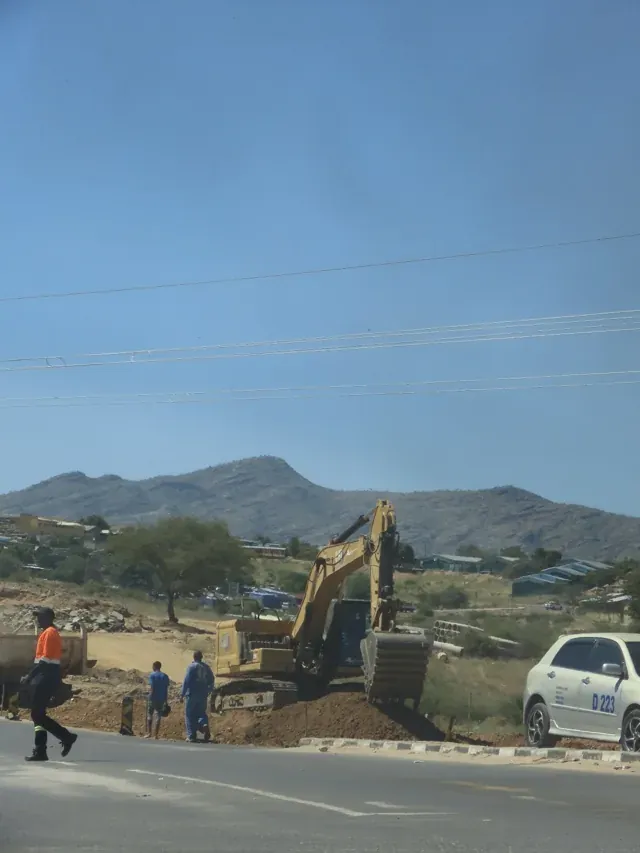
An excavator at a road construction site.
Operating context

An excavator at a road construction site.

Gwasheya · CC0 1.0 · WebP
Data for your assessment
Operating recordWhat to collect
Operating metricLitres per tonne moved
Compare like with likeSeparate idle, digging and travelling time
Costs to recordFuel and labour per job

An evidence-led approach

01

Establish the baseline

Document fuel, operating hours, load and the relevant output.

02

Assess options

Consider operational measures and suitable technologies against the specific application.

03

Measure and evaluate

Compare results against a representative baseline and include implementation costs.

Discuss technology use for your construction equipment

Describe your construction machinery and heavy equipment, their engines and typical operating conditions. Discuss with our team what information is needed to assess a potential application.

Discuss potential applications